
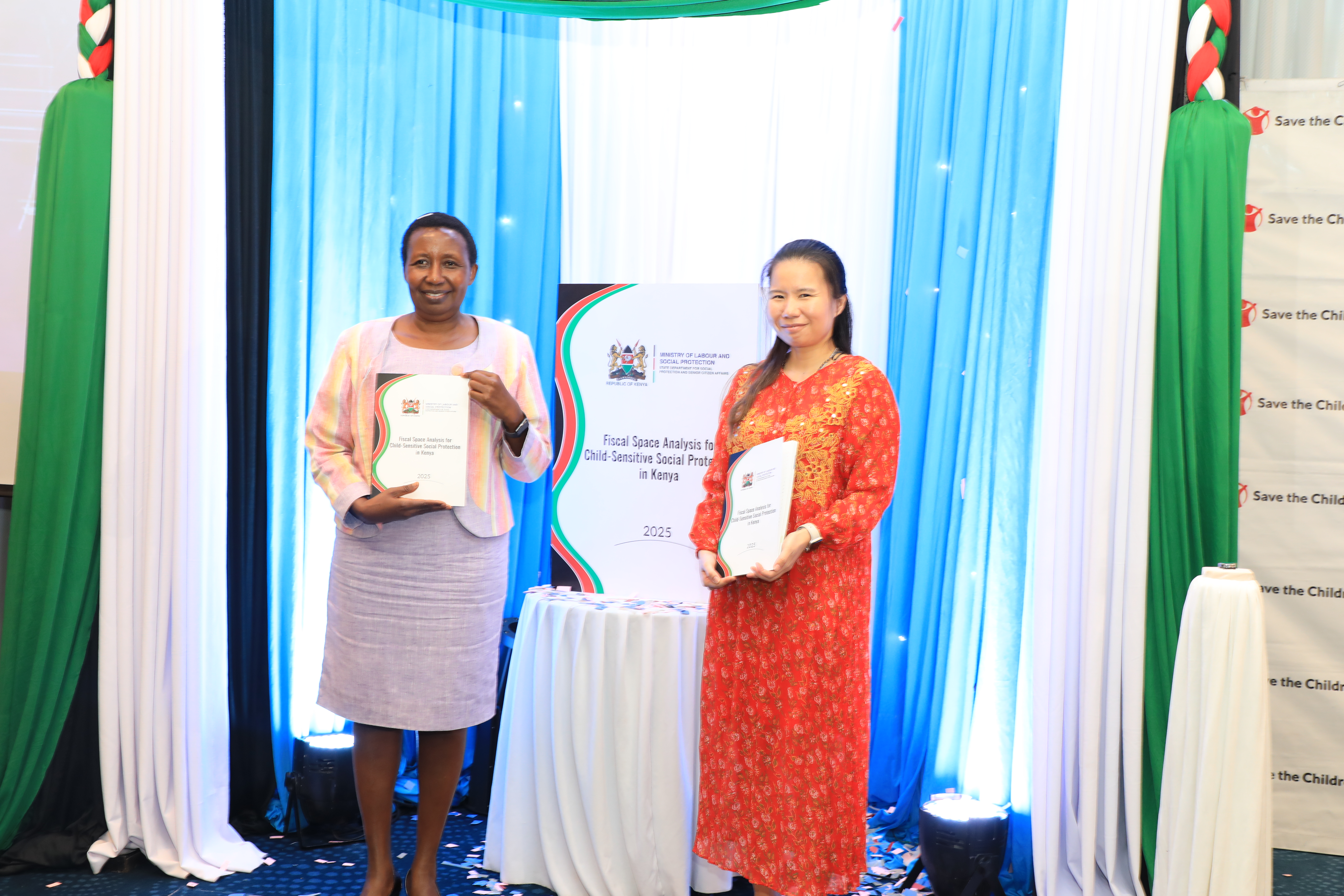
Agencies push for inclusion of vulnerable infants in social protection fund
Emmanuel Mbuthia and Winnie Saha-KNA
The State Department for Social Protection and Senior Citizen Affairs, in partnership with Save the Children Kenya and Madagascar Country Office, has launched the Fiscal Space Analysis Report on the Universal Child Benefit (UCB) Programme.
The Fiscal Space Analysis Report looked into budgeting, accounting, managerial-financial reporting and related activities such as internal auditing and management analysis on the pilot UCB Programme which was launched in December, 2021 to December 2022.
The UCB programme provided financial relief to Kenyan children, with a total of 8300 Children between the age of 0-36 months, benefiting from the exercise, receiving Sh800 per month per child.
The Principal Secretary (PS) for Social Protection and Senior Citizen Affairs Joseph Motari emphasized the need to prioritize children in national development underscoring the importance of ensuring no child is left behind.
“We often talk about public participation, but how often do we include children in budgeting processes? It is time we take decisive action to ensure children are part of key development conversations,” implored Motari in a speech read on his behalf by the Director, National Social Protection Secretariat, Jane Kitili.
The PS noted that beyond income, many children face multiple deprivations, such as limited access to safe water, healthcare, and education.
“A well-structured Universal Child Benefit can help bridge these gaps and transform the lives of children across Kenya,” he advised.
The UCB initiative was piloted in Kajiado, Embu, and Kisumu counties, where the program was complemented by health, nutrition, and disability inclusion interventions.
According to Motari, key findings from the pilot program included Reduced financial strain on families, allowing them to prioritize essential needs, and Improved child health indicators, with caregivers using cash transfers for nutrition.
The other major key finding was higher school attendance and better early childhood development outcomes.
“The pilot program demonstrated that scaling up UCB can yield substantial returns, helping break the cycle of poverty while fostering long-term national development,” he established.
The PS revealed that despite the success of the pilot, only 11 percent of eligible children in Kenya currently access social protection programs, leaving a vast majority vulnerable.
He emphasized the need for urgent action to bridge this gap and ensure all children benefit, rallying, “With children making up more than 50 percent of the population, this coverage gap is alarming. It is our responsibility to find solutions that will guarantee universal social protection for all children.”
Meanwhile, Motari pointed out that the Fiscal Space Analysis Report explores viable revenue streams and cost-saving measures to sustainably finance a nationwide UCB program.
It further calls for evidence-based policymaking, stronger coordination among government agencies, and increased support from development partners and civil society organizations.
In her remarks, Country Director, Save the Children International, Pornpun Jib Rabiltossaporn, emphasized the government’s commitment to strengthening social safety nets for children.
“The Government of Kenya has made significant progress in expanding social protection coverage,” she reaffirmed.
According to the Country Director, targeting mechanisms in social assistance programs often exclude many deserving children, whereby the UCB model eliminates this issue, ensuring no child is left behind.
“The findings of this report provide a roadmap for the government and development partners to take bold, transformative steps that will have a lasting impact on Kenya’s children,” she remarked.
On the other hand, stakeholders at the event urged the government to prioritize a progressive scale-up of the UCB program, beginning with children currently enrolled in the Cash Transfer for Orphans and Vulnerable Children (CT-OVC) program.
With continued collaboration and increased investment, Kenya aims to expand social protection coverage, ensuring that all children, especially the most vulnerable, have access to the support they need to thrive.