
Teacher retraining, curriculum overhaul underway for CBE rollout
Naif Rashid and Amenya Ochieng- KNA
The Government has reaffirmed its commitment to Competency-Based Education (CBE), describing it as a transformative model central to the country’s development agenda.
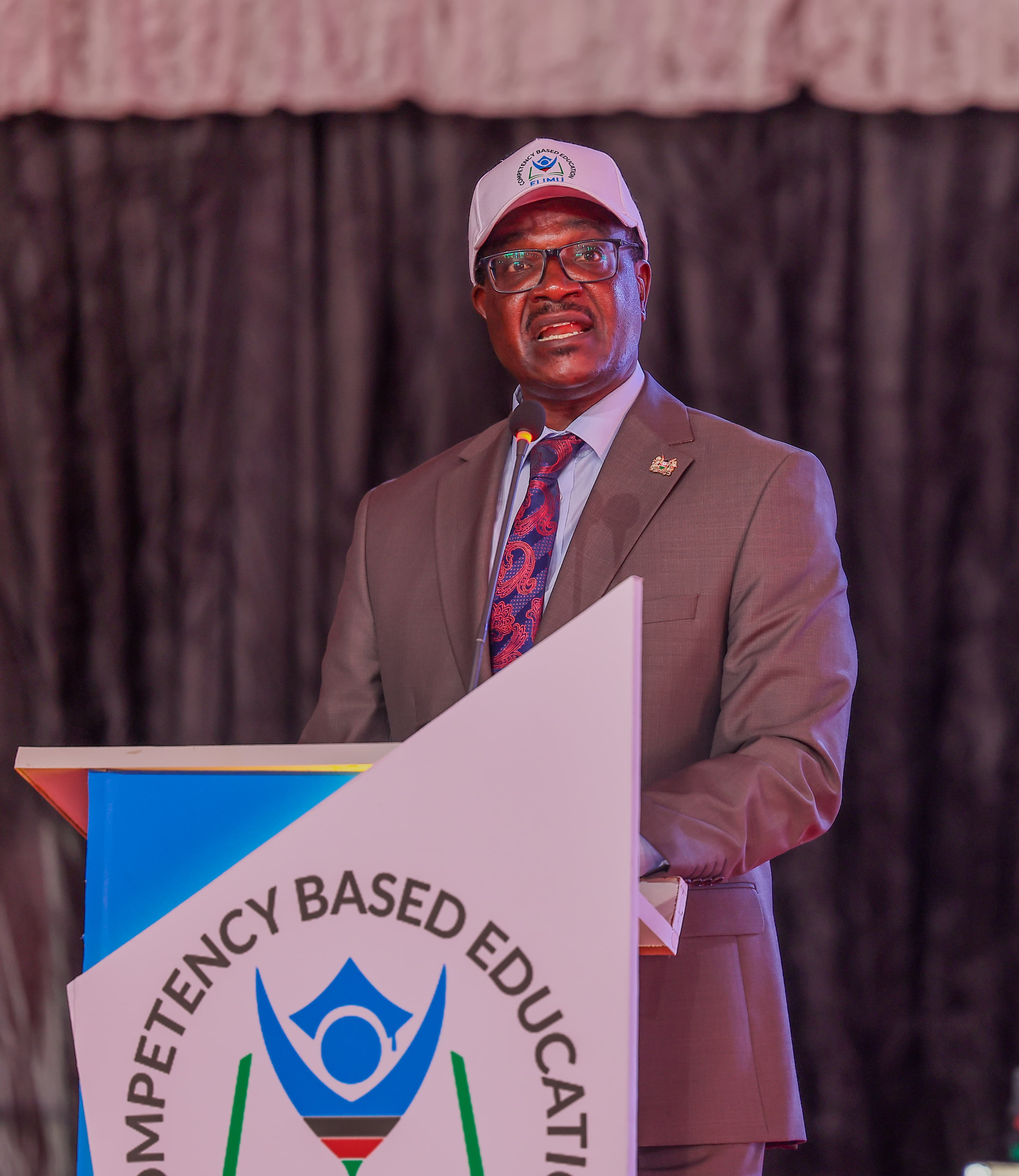
Speaking during the launch at the Kenyatta International Convention Centre (KICC), Education Cabinet Secretary Julius Migos Ogamba declared that CBE, also referred to as Elimu Thabiti, is the foundation of an inclusive, skills-based education system designed to prepare learners for the realities of the 21st century.
“Behind every education reform is a child, whose dreams depend on it. We are all in this together,” Ogamba said. The CS also emphasized that the CBE model is rooted in grassroots consultation and reflects the voices of communities across the country.
“Mathematics will now be compulsory across all senior secondary school pathways,” the CS said, adding that the technical team will work closely with the Kenya Institute of Curriculum Development to guide its implementation.
Further, Ogamba urged educators to embrace a new approach to teaching: “We must move away from rote learning (the method of memorizing information through repetition rather than understanding the underlying meaning or context). Our focus is on dynamic, learner-centered methods that inspire creativity, critical thinking, and problem-solving,” he added.
Making his remarks, Basic Education Principal Secretary (PS) Prof. Julius Bitok emphasized that CBE is not just a modification of the Competency-Based Curriculum (CBC) but a full transformation of Kenya’s education ecosystem.
“We are no longer just talking about curriculum; we are now implementing a system-wide reform,” Prof. Bitok noted. The PS highlighted insights from county-level consultations, singling out Nakuru, where students showcased innovation and hands-on skills demonstrating the practical impact of competency-based education.
“This is not just a curriculum shift; it’s a national transformation, and the future of our children depends on how we walk this journey together, since CBE aligns with Vision 2030 and the Bottom-Up Economic Transformation Agenda,” he said.
On her part, Higher Education and Research PS Dr. Beatrice Inyangala added that CBE also transforms teaching practices and learning environments.
“We must move away from teaching students to simply memorize. Instead, we should show them how to apply what they learn, and they will remember,” she said.
Dr. Inyangala emphasized the importance of continuous teacher retraining, active community participation, and school programs tailored to local contexts as essential components for the successful implementation of the competency-based education model.
Meanwhile, preparations for the national rollout are already underway. Universities, teacher training colleges, and curriculum development agencies are aligning their frameworks to accommodate the first cohort of CBE learners expected to transition to university by 2029.
Elsewhere, the Center for Mathematics, Science, and Technology Education in Africa (CEMASTEA) has urged the national government to allocate more funding for the retooling and retraining of teachers.
This would ensure the success of the competency-based curriculum (CBC) as it continues to be rolled out.
Speaking after a weeklong workshop for Lamu County Principals held in Lamu, Martin Mungai, Deputy Coordinator for STEM at CEMASTEA, stated that the national government’s move to implement the CBC syllabus requires teachers to be supported with adequate training as the program moves into Grade 10.
He emphasized the need for greater support not only in terms of training but also for equipment and facilities, such as laboratories, to ensure the successful transition and adoption of STEM subjects under the CBC syllabus.